THE LIFELONG IMPACT OF ILLITERACY
15 December,2020
“Illiteracy is one of our world’s biggest problems today, along with peace, hunger and disease.
A large part of our world is functionally illiterate ... about a billion people are illiterate and another billion barely so.
This is a major loss to the world, causing disenfranchisement, disaffection, disillusionment, dysfunction, and costing us an estimated $1 trillion in lost productivity.
We are trapped in a vicious cycle:
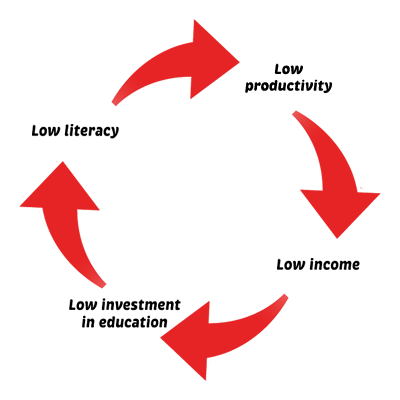
The consequences are devastating, for individuals, nations and the world:
The illiterate die young, and their children do as well
They earn less money
They are likelier to go to prison, even in developed countries
Their societies experience more crime, disease, poverty, lawlessness, social unrest, intolerance, and upheaval
There is a strong correlation between illiteracy and poverty, poor health, and crime in almost every society in the world.
Among nations, countries with higher literacy invariably have higher per capita income. There is a positive, exponential relationship between literacy rate and GDP per capita.
Conversely, the benefits of education are tremendous.
Taking only GDP as one factor, an increase of 1% point in global literacy would increase world GDP disproportionately, by billions of dollars. The opportunity is significantly larger and amplified further when the social benefits of education are taken into account.
The social impact
When a person struggles with reading, the social impacts are profound. A person who is unable to read may have low self-esteem or feel emotions such as shame, fear, and powerlessness. Students who struggle with literacy feel ostracized from academia, avoid situations where they may be discovered or find themselves unable to fully participate in society or government. Says Dwyer, “Literacy permeates all areas of life, fundamentally shaping how we learn, work, and socialize. Literacy is essential to informed decision-making, personal empowerment, and community engagement. Communication and connection are the basis of who we are and how we live together and interact with the world.”
A person who cannot read struggles to know their rights, to vote, to find work, to pay bills and to secure housing. All told, this complex struggle spirals outward, impacting future generations and our society. “Illiteracy impacts an individual’s opportunities to fully participate in a democratic society,” says Leigh A. Hall, professor and Excellence Endowed Chair in Literacy Education at the University of Wyoming. “It doesn’t just have a negative effect on that person’s life, but on the overall health and well-being of our country.”
The multigenerational impact
Illiteracy often passes from generation to generation, regardless of whether children attend school. “Many children around the world attend school but do not learn to read, write, or calculate… Many of these adults experienced such frustration as children that they deliberately avoid literacy-related activities in later life. When they have children of their own, they tend to communicate (often non-verbally) their negative feelings towards literacy and schooling to their children, and thus perpetuate an intergenerational cycle of illiteracy,” according to UNESCO’s “8 Learning Families – Intergenerational Approaches to Literacy Teaching and Learning.”
The connection between parental education and the literacy of their children has been examined in numerous studies. Research by the U.S. Department of Education found that “children who are read to at least three times a week by a family member are almost twice as likely to score in the top 25% in reading compared to children who are read to less than three times a week.”


'%20x='0'%20y='0'%20height='100%25'%20width='100%25'%20xlink%3Ahref='data%3Aimage/png;base64,iVBORw0KGgoAAAANSUhEUgAAAAoAAAAFCAIAAADzBuo/AAAAl0lEQVQI1yXKsQrCMBAA0Py5u36Bs4NURyEIRegiLpk6tRWTphqa5rz0SE0KdnHwzY9praWUTdNYa7uXMboFgBCC9945xwAAAFJKt9ZtMq63q/EhjDH/xHTXfWKMKV6r/HB/w2Vd5Py7LDElpRRDxBDCSF7WO1HzY7Y/FWKe52maiIiVZYmIRJSwoic/C2WArLV93w/D8APA1oMqN/q6HwAAAABJRU5ErkJggg=='%3E%3C/image%3E%3C/svg%3E)